Another Hybrid OB Speaker Manufactuer
Look’s like I am not the only person on the planet doing a hybrid open baffle speaker after all. I was just reading the January ’15 issue of TAS magazine when I noted on page 20 – The 2014 New York Audio Show – Five Most Significant Products. This other brand is the Nola Metro Grand Reference Gold costing only $33k. I think I can do cheaper although the deep finish polished wood is beyond my skill set.
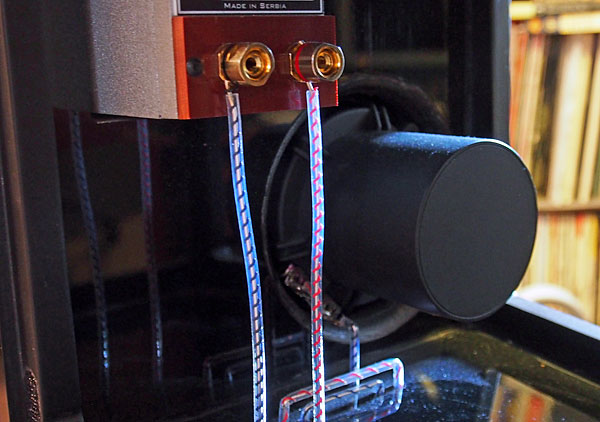
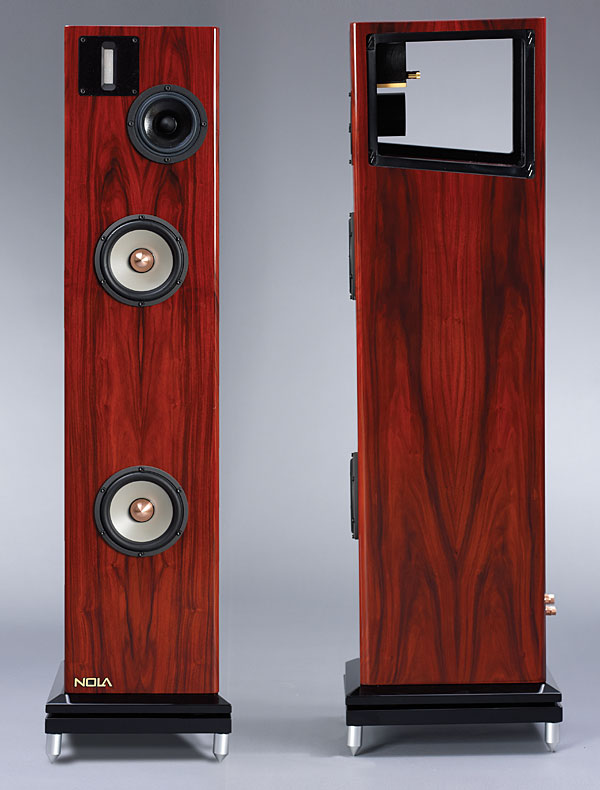
In the Nola there are two 6.5″ SEAS Excel drivers for the bass mounted on the front baffle, each loaded with its own asymmetrically proportioned, ported chamber, vented to the rear. heir midrange is covered by a 4″ paper cone and a ribbon tweeter.
So, how does this compare to my own efforts you might ask and which is cheaper?
Firstly, my hybrid is a boxed woofer and both midrange and tweeter on an open baffle. The difference here is that much more of my 8″ midrange is exposed to the rear and my tweeter in the AMT-700 dipole whilst the Nola is not a dipole. This means I get much closer to the ideal rear cardioid figure 8 pattern then the Nola. In addition, I to am also using the SEAS Excel drivers – in my case it is the 8″ which I am using for the midrange whilst Nola have missed the point of the magnesium midrange by reverting to paper cones for this important part of the spectrum. I am assuming their problem is the conal resonance above the pistonic range that they failed to control whilst using passive cross overs. And this is defiantly one of the prime reasons for using an active high slope filter.
Another design failure of thew Nola for me is that the open baffle is not running lower enough into the upper midrange where most of the advantage of open baffle lies. I conclude this because of their use of a 4″ midrange as opposed to my 8″ which better couples to the open baffle speaker design. That is, due to baffle board roll off of 6 dB per octave, larger drivers combined with equalization are required in order to get down to 200 Hz. This is really the critical range to bring instrument such as piano, double bass and electric guitar to life in a living room.
Next the bass. Firstly, I concede that the SEAS Excel is going to sound better then my SB Acoustic 12″ modified paper cone driver. However, Nola have gone for the Hi Fi effect of attempting to reach 25 Hz using a vented cabinet, as do ~99% of all speakers. That is because the vent is efficient suing less amplifier power and will have a lower 3 dB point of in this case – 25 Hz. I however have turned my back on that design, again added by active cross over and the availability of cheap high power class D power amps. So yes, my -3 dB point is only 39 Hz but guess what? This is not critical to music listening as 95% of music does not go below 44 Hz, the bottom string of a bass guitar or double bass. Just ask JBL and other pro speakers for their -3 dB point to verify my design principle.
But the above discussion still misses the point on why my bass sounds better even with a higher distortion bass driver – it is the box design. I am using an infinite baffle design, that is one that is not vented. With a Qtc of 0.68 I can’t tighter sound with better transient attach, no flab and I don’t suffer from over extension of the cones at the vent resonance frequency. Yes I do use more power but interestingly, I have never over driven these SB Acoustic driver and I have punished them with enough Eq to reach a -3 dB point of 30 Hz. Good enough for me.
In summary: I like what Nola are attempting but they have had to compromise too much. For less money, including the DEQX, I am doing far better. For a hybrid open baffle I would have ultimately gone for a better driver then the AB Acoustics, this is part of my learning curve, and no I still wouldn’t choose the SEAS Excel, although they would be my second choice.
Patrick


Recent Comments